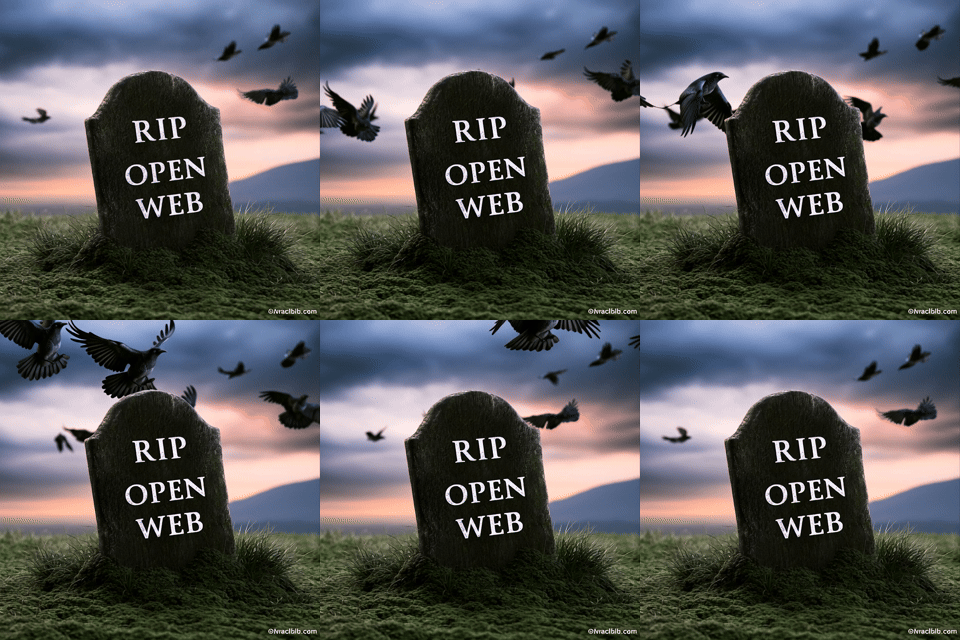

The open web is dead. Not dying, not on life support, not “facing headwinds.” Dead.
Yes – I am being a drama queen but it is justified. The Open Web has two sides to it – the ad side and the human side. No matter how you look at it – the conclusion remains the same. The Open Web is gone – for advertisers and consumers alike.
For years the advertising industry has argued about whether the Open Web can survive the walled gardens. Look past the ad budgets to what happens when an ordinary person clicks a link to understand the news, and the verdict is already in.
The web we were promised was simple: anyone could publish, anyone could read, and the best information would be a click away for everyone. That web is gone.
The debate everyone in adtech is having
Inside the ad business, “Open Web versus walled gardens” is the defining fight of the decade. On one side sit Google, Meta and Amazon, with their closed ecosystems, first-party data and self-graded measurement. On the other sit the independents, led by The Trade Desk, which has spent years casting itself as the champion of the open internet. It even ran a brand campaign built around the line “Because the Open Internet Matters” (WARC).
CEO Jeff Green has kept the faith publicly. On the company’s May 2026 earnings call he said the open internet is thriving, and predicted most walled gardens will eventually open their inventory and join it (Q1 2026 prepared remarks).
The market tells a different story. Ad budgets have been concentrating inside walled gardens (eMarketer). Evidence from Google’s antitrust trial suggested open internet spending has been roughly flat since 2019 (TIKR). In March 2026, Publicis reportedly told clients it no longer recommends The Trade Desk. Even Green, on an earlier call, conceded the Open Web vision was “more aspirational than factual” (eMarketer).
That is the debate brands obsess over: where the dollars go. But it is only half the story.
The other half: the paywall era
The other story is not about where ad dollars land. It is about where readers land. Click a link to almost any serious story today and you hit a pay wall: subscribe, register, or go away.
Publishers trying to make ends meet have moved, one by one, behind paywalls. Newspapers, magazines, trade titles, even niche newsletters now gate their best work. The Open Web still exists as an address bar. As a place where you can actually read the story, it is shrinking fast.
And the audience willing to pay is small. Years of Reuters Institute surveys have found most people simply will not pay for online news; across 20 markets the share paying sat around 17% and growth was described as levelling off (Press Gazette). Commentary on the 2026 report noted the US share paying fell seven points in a single year, to 13% (Deccan Chronicle).
Publishers aren’t the villains
There is nothing inherently wrong with charging for journalism. Good reporting is expensive. Editors, fact-checkers, lawyers and correspondents all cost money, and none of them work for free.
Programmatic advertising promised to fund all of it. It didn’t. By the time an ad dollar passed through the agency, the DSP, the SSP, the data vendors and the verification layer, the publisher kept a sliver. Meanwhile, cheap made-for-advertising sites competed for the same budgets, and the walled gardens took the lion’s share anyway.
For many Open Web publishers, the math stopped working. Producing a well-reported story could cost thousands of dollars; the programmatic ads beside it returned pennies per reader. Asking readers to pay directly was not greed. It was survival.
How programmatic media killed the Open Web
The promises of programmatic were rosy at first. It was what VCs funded. Better targeting, better data and better accountability. Except it did not work out that way. Programmatic advertising promised publishers an endless stream of automated revenue, but it ended up starving the very sites it was supposed to support.
Programmatic engines turned every ad impression into a commodity auctioned in milliseconds, flooding the market with near-limitless supply. Premium journalism ended up competing on price with clickbait farms, made-for-advertising sites, and the walled gardens, and when supply is infinite, prices collapse.
CPMs fell to levels where a carefully reported story, which might cost thousands of dollars to produce, earned only pennies per reader. Even those thin margins were shared with a long chain of middlemen. Publishers chased volume with more ads, more pop-ups and more autoplay, which only drove readers to ad blockers and pushed CPMs lower still. Eventually the math simply broke.
Advertising could no longer cover the cost of quality content, so publishers turned to the one revenue stream programmatic couldn’t commoditize, which was readers themselves. The paywall wasn’t greed. It was the bill for a broken ad model, and the Open Web is what paid it.
The cost: the full story is for paying customers only
Here is the problem. On almost any story that matters, the headline is free but the content is not.
You can see that a bill passed, but not what is in it. You can see that a company’s stock collapsed, but not why. You can read the outrage on social media, but not the reporting underneath it. The facts, the nuance and the “here is what this actually means” sit behind the wall.
What leaks out is the least useful part: a headline, a teaser, a screenshot stripped of context. That fragment is what travels. Then it gets argued about by millions of people who never saw the rest.
Who gets locked out
This is bad for everyone, because no one has a way to see the whole truth.
Consider two readers. The first wants to be well informed and reads widely. A national paper, a business title, a local outlet and a couple of specialist publications can easily add up to more than a hundred dollars a month. Most households cannot justify that, and many cannot afford it at all.
The second reader just wants one article. They clicked a link a friend shared and want to know what happened. They do not want a subscription, a login, a trial that auto-renews, or a cancellation maze. There is still no simple, widely adopted way to pay for a single story, so they bounce.
The result is a two-tier information economy. People who can pay get context. Everyone else gets fragments.
No referee, so everyone shouts
There are almost no trusted outlets left where anyone, regardless of income, can get reliable news and information for free. A handful of public broadcasters, some local news outlets and donation-funded sites still try. But they are few, stretched thin, and financial vulnerable.
That absence explains a lot of today’s rancor. A society needs some shared baseline of facts to argue from. When the most rigorous reporting is locked away, there is no arbiter of fact available to all. The vacuum is filled with whatever is free: partisan feeds, influencers, recycled screenshots and algorithmically amplified anger.
People are not just disagreeing about what to do. They are disagreeing about what happened, because they are reading entirely different, and often incomplete, versions of events.
RIP, Open Web
So yes, The Trade Desk and its peers can keep fighting for the open internet’s share of ad budgets. That fight may even matter for their stock price. But the battle that counted, keeping quality information open to everyone, is already lost.
The Open Web was never just an advertising channel. It was a promise that knowledge would be a click away for anyone.
Walled gardens took the attention.
Programmatic media took the profits.
Paywalls took away the substance.
What’s left in between is an Open Web in name only.
It was a beautiful dream. Rest in peace, Open Web. Nice knowing ya.
(I mourn the loss of the Open Web more profoundly than many because I helped launch “the Web” at Bell Labs in the late 1990s. I saw the dream and the vision. I see where we landed. The gap between what could be and what is – runs wider and deeper than it should have been. Read more here: In the room where it happened.)