
An honest look at how software became a rental business, why the model is buckling, and what comes next.
Software-as-a-Service did not arrive as a grand strategic insight. It arrived as a generational memory. The executives who built the SaaS wave of the 2000s and 2010s came of age inside the software industry of the 1980s and 1990s, an era in which shrink-wrapped software was one of the most profitable products a company could sell.
A single license could carry margins most industries would kill for, and the software companies of that era knew it. But those same executives also watched the other side of that ledger up close: the endless maintenance contracts, the version upgrades nobody wanted to pay for twice, and IT departments buried under patches, service packs, and support tickets for software that had already been paid for in full. Enterprises spent a fortune buying software and then spent almost as much keeping it alive. That tension; huge upfront cost paired with a maintenance burden that never really ended, was the seed the Software as a Service (SaaS) model germinated from.
As those managers matured into executives and, in many cases, venture capitalists, they carried that memory with them. They sensed Software as a Service was the future of software sales and VCs were the first to fully appreciate the significance of the SaaS model.
That is also why VCs were first to so heavily favor ventures that were SaaS-based. In the past 20 years, virtually all ventures funded by VCs were one version or another of SaaS businesses.
The SaaS business model was so successful because it is actually very simple. Host software centrally, charge a monthly or annual fee, and eliminate most human labor costs that weighed down the profits of the software selling business. We can all acknowledge that SaaS was a genuinely clever response to a genuine customer complaint, and it deserves credit for solving a real problem in an innovative way.
That said, the appeal of SaaS to the venture capital community, though, was never purely about solving a customer issue. It was about the shape of the revenue itself. Venture capitalists are, at their core, in the business of underwriting risk against a return, and nothing de-risks an investment quite like revenue that repeats itself without a corresponding sales effort.
A one-time software sale requires a new sales campaign to generate the next dollar. A subscription, once signed, generates that same dollar again next month with no additional selling required. Successfully acquire customers “at scale” and the result starts to resemble an annuity: predictable, compounding, and, critically, forecastable years into the future. That forecast-ability is what makes a SaaS business fundable. It is also why SaaS became not just a popular business model but very nearly the default one; for the better part of two decades. If a startup wanted venture funding, it needed a subscription story to tell.
On paper, the economics looked solid. Build the platform once, and the marginal cost of serving the next customer approaches zero. There is no factory to run, no large workforce, no inventory to hold, no shipping to manage. The venture takes on real risk during the build phase, and then, once the product finds a market, the ongoing cost structure is thin while the revenue keeps arriving whether or not the sales team makes another call that month. It is easy to understand why an entire generation of founders and investors treated the SaaS subscription as virtually the exclusive business model worth the time and investment.
Yet, for all the surface appearances of a “perfect” business model, there were visible cracks in the SaaS edifice pretty early on. Those cracks have only widened as the market has matured.
The first crack is fragmentation. A modern company’s operations rarely run on a single platform; they are stitched together across a dozen or more SaaS tools, each excellent at its own narrow function and largely indifferent to the ones sitting next to it or below it or above it. Lead generation runs in one system and sales outreach is handled in another platform. Campaign management is managed in one SaaS platform while analytics rests in another platform. The burden of making them talk to each other falls entirely on the customer. What was sold as simplification quietly became a management burden of its own, one that simply shifted from the vendor’s side of the ledger to the customer’s.
The second crack is data. Not just data integration as discussed above, but data standardization. Defining a “new customer” in a CRM platform must be consistent with how a “new customer” is tagged in an email platform. It is not enough for the company’s operations to talk to each when they are spread across several platforms, its data hierarchy must be consistently applied across all platforms and customer touchpoints. This is no easy task. Reconciling customer records, transaction histories, and reporting figures between systems that were never designed to share a common data architecture becomes a grinding and expensive tax on every team that has to do it. None of this shows up in a SaaS sales demo. All of it shows up eighteen months into a contract, once the honeymoon has ended and the operational reality has set in.
The third crack is customer competence. Most SaaS platforms are built with an enormous amount of configurability, and configurability is only valuable to the customer who knows how to use it. DSPs (Demand Side Platforms) are a good example of this. They are, by definition, complex to get the full value out of them. These platforms need the right workflows, connecting the right integrations, building the right reports, all of which requires a level of technical fluency that most customers simply do not have in-house and never expected to need when they signed the contract. SaaS sold functionality but what clients actually needed was expertise, and expertise was not part of the deal.
It turns out though, that the deepest flaw in the SaaS model was never technical at all. It was a business assumption baked into the model from day one: that a well-built platform does not need human services or support behind it to succeed. If the software worked, the thinking went, it should sell and support itself.
That assumption is what allowed SaaS companies to keep headcount thin and margins fat, and it is also what quietly broke the relationship with the customer. Software, however well designed, does not diagnose why adoption is stalling inside a particular department, or why a sales ceiling has been reached. Without a robust support and services layer wrapped around the SaaS platform, customers were left to figure all of that out on their own, and a great many of them didn’t. They struggled in silence, extracted a fraction of the platform’s actual capability, and eventually concluded that the product simply hadn’t delivered. Then they churned – the death metric for any SaaS business.
Nonetheless, VCs were adamant that a successful SaaS business was built with few people to support customers. People were expensive and SaaS works because it is cheap to operate.
This VC blind spot shows up, inconveniently, in the churn rate of SaaS platforms. Current industry benchmarking on monthly-billed, indicate that SMB-focused SaaS product churn runs as high as 30 – 50% compared to large enterprise who churn at about a 10% rate. Naturally, large enterprises have more resources to wrestle the platforms to the ground. Smaller organizations, by contrast, are under-served and left on their own. They understand a platform has great potential but they do not have deep resources to unlock the potential.
Sadly, most of the time, high churn rates is framed as a pricing problem, an onboarding problem, or a product-market-fit problem. That is skirting the reality. A high churn rate is often driven by services problem. If a SaaS business is losing 4 out of ten customers, they have a serious and very costly retention problem.
And nothing kills a SaaS’s profitability quicker than high churn rates.
Yet VCs blind spot continued unabated. Their attitude about adding people to a SaaS’ business model was immutable – a brick wall. I experienced the “brick wall” first-hand when we started our venture about 13 years ago. We wanted to get funding for the build of our acquisition tech stack. We packaged it as a SaaS play (a topic intelligence data platform) while hoping that we could convince VCs that a robust services component was needed. It was an epic failure because VCs simply did not believe a true SaaS business was people powered. In one case, a VC who had agreed to fund us backed out because we insisted on a services layer that was properly funded. This is when the VC’s words stunned me; “Judy,” he said, “you are just too invested in client outcomes.”
That nearly broke me, leaving me to ask whether I should give up. Ultimately, I did not break but it hardened me on the need to integrate robust services into our SaaS marketing acquisition technology – VC investment or not.
Direct experience taught us to reimagine the SaaS plus services offering that can excel at delivering complex marketing functions – profitably. (Sidebar – Not only did we survive, but we are thriving because acquisition is well-served with a delicate balancing of deep tech and even deeper experience and instincts.)
Today, it is essential to reorient ourselves in understanding that while SaaS is a tech platform that delivers functionality, it is primarily a SaaS business model that requires people to support and service customers.
The new SaaS Business Model
The fix is not to abandon the subscription model; it is to stop treating the platform as the whole business. That is clear. So what does SaaS business model v2.0 look like?
Experience is a great teacher so here is what we see as the SaaS business of the future. It rests on three core principles.
- It is functionally configurable rather than rigid, built to bend to a customer’s actual workflow instead of forcing the customer to bend to the software’s assumptions. This is particularly important as AI workflows dominate marketing processes. By being ready to adapt features to a client’s infrastructure, the platform is future proofed for the client. What a relief.
- Every SaaS solution is paired with a services contract for multi-step functions. A single function SaaS platform, such as those that shorten links, do not need a services module. However, any platform that manage a marketing process – from email to media buying – must include a standard services component. By the time the client realizes they need it – it is too late and something has gone wrong. That is not the time to insist on expensive add-on services contract when the customer is already frustrated. Read the room.
- The people services offering is organized to make all the elements hum; data integration, process tracking, marketing reporting, and data standardization. These elements can then be knitted together with shared data and AI insights so new levels of intelligence can drive the organization. This is easy to say and very very very difficult to do.
Put those three changes together and you get something that is not quite the SaaS model as the industry has known and not quite the old-fashioned managed-services model either.
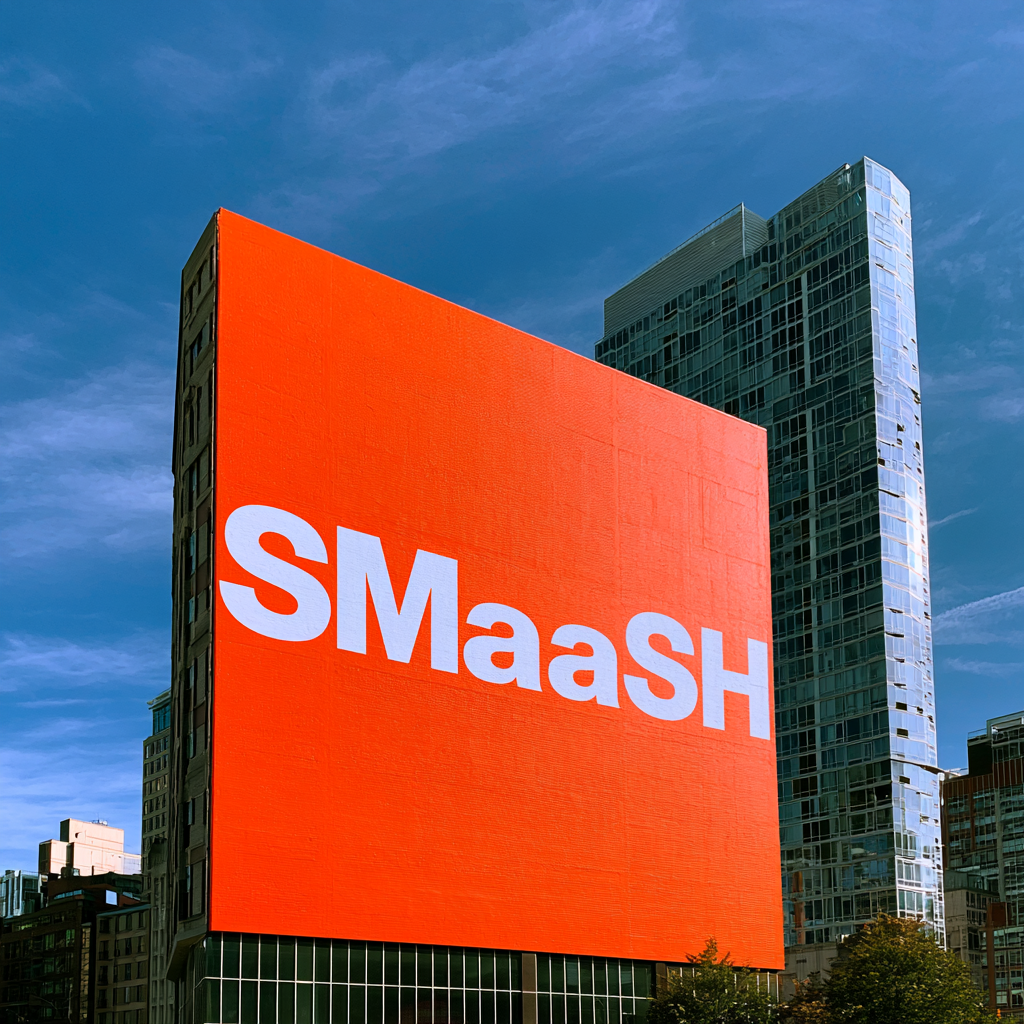
It deserves its own name which I affectionately name: SMaaSH –
Software and Management as a Service Hub.
The name is blunt on purpose. It says plainly that the software and the management of that software are one product, not two, and that a vendor’s job does not end at deployment; it continues for as long as the customer is paying, because that is exactly how long the customer needs the platform to keep working for them.
SaaS taught the industry that recurring revenue is powerful. SMaaSH is the correction that reminds the industry recurring revenue only stays recurring if someone on the vendor’s side keeps earning it, month after month, customer by customer.
SaaS, as a standalone business model, has run its course.
It is time we put it in its proper place: as one component of a service, not the whole of it. Welcome to the SMaaSH era.