
Guest Post from John Miller, President & Founder, Scribewise
The AI search era is here, and it’s awesome.
AI search is, somewhat paradoxically, a more human experience than traditional search. AI search is a better user experience—more in depth, more nuanced, more conversational and more authentic. And it rewards companies who market themselves in a more authentic, human-focused way.
In September, we at Scribewise conducted a survey of 205 marketers and leaders at professional services firms to gauge where they stand in their adoption of this new paradigm. You can find our GEO Readiness Report here.
The clear takeaway from our study is that professional services firms are aggressively adopting GEO strategies, shifting budgets as needed. 55% of marketers and firm leaders told us that their GEO strategies are “advanced.” Of those who aren’t quite there yet, 72% say that their GEO strategies will be up and running within six months.
The GEO mindset shift
Generative engine optimization (GEO)—optimizing to improve your firm’s visibility in AI search—is fundamentally different from traditional SEO.
One of the things we uncovered in our survey is that lots of marketers are under the illusion that GEO is “just the next evolution of SEO”—in our survey, 1 in 5 agreed with that statement. But, well, they’re wrong.
Of course, at some level, there is truth to what they’re saying. You still need to pay attention to SEO basics. But comparing SEO to GEO is like comparing a sparkplug to a car—the car won’t go without the sparkplug, but you can’t drive the sparkplug to wherever you’re going.
The chart below delineates the differences between SEO and GEO. If you want to boil down what works for GEO into a single phrase, I’ll say “authoritative content, well-distributed across the internet.”
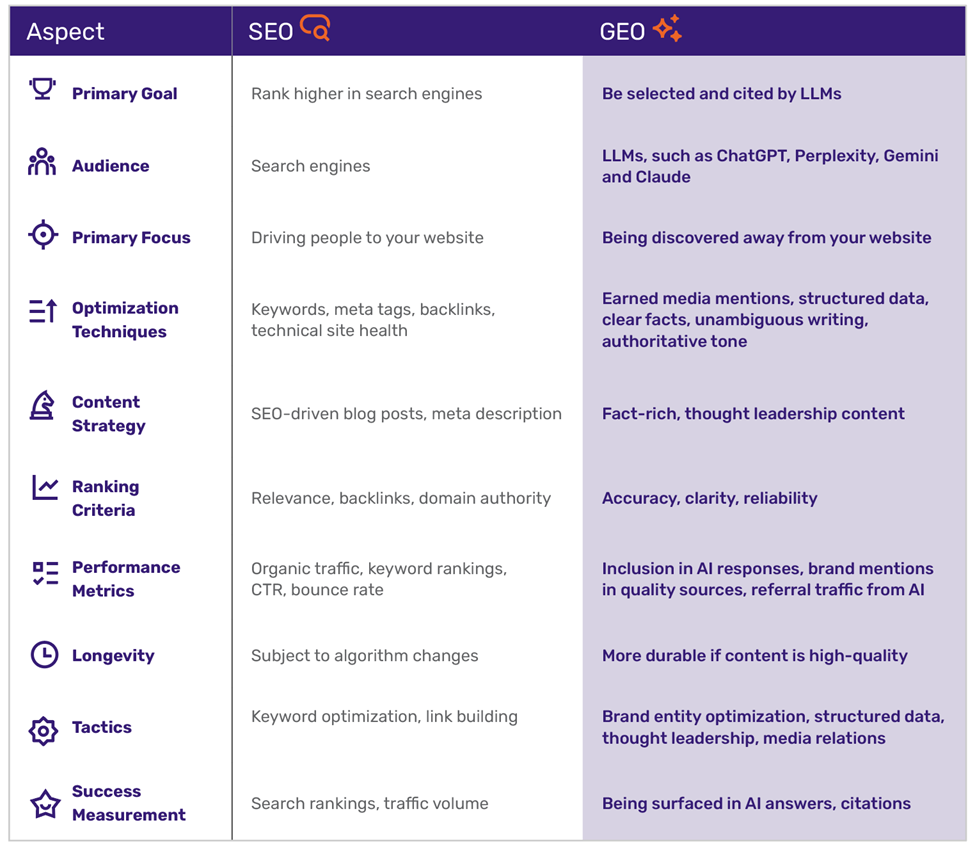
AI search synthesizes information from far beyond your website. It doesn’t assign credibility through something like PageRank; it assesses credibility based upon several factors—context, intent and relationships between entities. AI engines are not scanning your site alone to figure out what your firm is—it’s learning from data across the entire web.
Don’t get trapped playing the wrong digital marketing game
Most digital marketing advice is focused on SaaS and ecommerce companies. It doesn’t work for services businesses, which are typically long-consideration purchases.
At Scribewise, we work with professional services firms to make them “unignorable.” Our focus has never been on driving website traffic—no one ever landed on a consulting firm’s website and signed up for a six- or seven-figure project. A professional services firm is hired for its thinking—thinking is their product. We help them showcase that “product” through thought leadership—compelling content, well-distributed, that gets our clients noticed and helps them build trust with their future clients.
Talk to any marketer working at a services firm, and they will tell you the challenges they face in doing this—consultants focused on billable hours, writers who don’t have the depth of knowledge to understand the subject matter and an inability to go beyond surface-level ideas. This was okay in the SEO era—focus on a couple keywords, write long, and no need to interview an SME to get a deeper point of view (“dude, let’s write an epic post”).
That doesn’t work anymore (if it ever did).
Professional services buyers want layered nuance. They want to know that you really understand what you’re talking about. This is also what AI is looking to surface.
Creating thought leadership at this level is not easy. It’s certainly another reason why marketers say they’re concerned about the AI search era—succeeding will be hard work that requires a deep skill set. A lot of folks who’ve been successful in the SEO era don’t have those skills. And a lot of people don’t want to work that hard.
The people who have a modicum of talent and are willing to do the necessary intellectual pushups are the ones who will win.
AI search is a bit confounding. That’s okay.
In our survey of firm leaders, 45% told us that one of their biggest concerns is that AI search engines are “more obtuse” than traditional search engines.
The SEO playbook is tried and true—identify the keywords you want to rank for, create content that includes those keywords, seek out backlinks, and your website traffic will go up. You could market to the algorithm. Sure, the algorithm changed frequently, but Google always made sure to provide enough guidance to make sure you stayed addicted to their platform.
AI search is harder to figure out. What works and what matters seems to change at lightspeed—the tactic that seemed like a cheat code two months ago barely makes a ripple today.
This is exactly what we mean when we say that we need to shake off the old SEO mindset. The SEO mindset is extremely transactional—add these inputs, get those outcomes. The AI search mindset requires us to be less transactional, and to focus on the more human aspects of brand building and marketing—be provocative, be helpful, be trustworthy.
SEO professionals have a methodology. AI search pros need to have a philosophy.
Don’t look for an itemized checklist of marketing activities. Focus on becoming known for something, something that matters to your audience. These are the signals AI search engines are looking for.
___________________________________________________________________________________________________________________________________________________
About the Author: John Miller is the founder of Scribewise and the author of Playing It Safe Sucks: A Manifesto for Courageous Marketing. John has spent his career helping firms to get noticed and build trust through bold marketing programs.
Before Scribewise, John was a principal at one of the mid-Atlantic’s top public relations agencies. He also worked as an award-winning broadcaster for a number of TV and radio stations, most notably as the pre- and postgame radio host for the Philadelphia Eagles. Go Birds.