

Why B2B Struggles to Show ROI with AI
The numbers are in, and they tell a familiar story. As the latest wave of AI adoption data rolls across boardrooms and budget meetings, a stubborn truth is emerging: most B2B organizations cannot draw a straight line between their AI investment and a measurable return. They know something is happening. They sense productivity is shifting. But the hard numbers that justify the spend? They remain elusive.
According to Marketing Charts, only 23% of B2B respondents report that AI is achieving clear and measurable ROI. Compare that to the B2C and hybrid world, where more than one-third (34%) of respondents say the same. Notably, in both B2C and B2B in the best of circumstances, only one in three companies are able to draw the AI/ ROI line. While B2C are not having an easy time of it, B2B are really struggling because it reflects something structural about how B2B organizations are wired, how they buy, and how they measure success.
Déjà Vu: We’ve Been Here Before
If the “Missing ROI” story sounds familiar – it should. We saw this exactly same scenario in the digital transformation. The first five years were chaotic and messy (roughly 2005 – 2010). Uber’s COO perhaps put it most candidly very recently: “That link is not there yet. Maybe implicitly there’s more that is getting shipped, but it’s very hard to draw a line between one of those stats and ‘Okay, now we’re actually producing like 25% more useful consumer features.’” Coming from one of the most data-sophisticated companies on the planet, that admission should give every B2B leader pause.
Executives bought expensive CRM platforms and agencies sold transformation roadmaps but the results remained stubbornly intangible. It was during this period that Gartner introduced its now-famous Hype Cycle — a framework that gave language to what everyone was experiencing: inflated expectations crashing into the trough of disillusionment before eventually climbing toward the plateau of productivity. Most telling, it was meant to explain the gap between an innovation’s introduction and its real-world financial application.
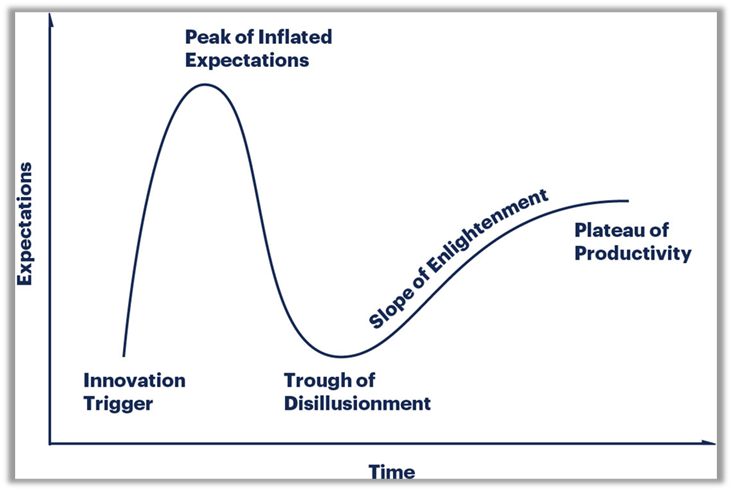
The sense of déjà vu is real and reflects almost exactly the story that played out during the digital transformation era.
AI is riding the same curve. The peak of inflated expectations — supercharged by ChatGPT’s explosive entry into public consciousness — is now meeting the trough of disillusion in the enterprise’s reality. The technology is real. The potential is real. But the gap between capability and measured business impact is also very real, and in B2B, it is wider than most would like to admit.
The question is not whether AI will deliver ROI. History tells us it will. The question is how to accelerate the journey from chaos to productivity without wasting another three years and several budget cycles in the process.
Why B2B Feels the Pain More Acutely
Before exploring the solutions, it is worth understanding why B2B lags behind B2C in AI ROI measurement. B2C businesses benefit from shorter feedback loops. A consumer clicks, converts, or churns within hours or days. Attribution models, while imperfect, have decades of refinement behind them. When an AI-powered recommendation engine on a retail site lifts basket size by 4%, that number surfaces quickly and cleanly.
B2B buying cycles are measured in months, sometimes years. Multiple stakeholders touch every deal. Influence is distributed across channels, conversations, and touchpoints that are notoriously difficult to track. AI might meaningfully improve qualification, content personalization, or proposal quality — but the revenue impact of those improvements may not register for six to eighteen months, long after the quarterly review that decided whether the AI investment would continue.
Finally, B2C organizations benefit from deeper cohort data – psychographics, interests, and topics. B2B data is confined to limited and flawed data – industry, size of organization, and maybe titles. These data points are often wrong or worse, targeting the CIO in an organization often has nothing to do with the actual advocate for a tech.
Together, B2B is highly susceptible to structural complexity; sales cycles, data environments, fragmented CRMs, disconnected marketing stacks, inconsistent data hygiene. All these friction points make it hard to know where AI is best applied to drive revenue. The confusion is not really about AI alone but about AI in the context of a complex conversion cycle. Once we compartmentalize AI complexity from operational measurement complexity, then we can start to understand how to use AI productively. Ironic that the goal to understand how to use AI well in B2B is a task no AI tool can solve on its own.
What To Do: A Practical Path to Measurable AI ROI
The organizations that are breaking through the measurement fog are not necessarily using more sophisticated AI. They are approaching the challenge differently. Here is what the evidence and emerging best practice suggests.
1. Get Ruthless About Data: What Matters and What Does Not
The biggest accelerant of AI ROI is not a better model. It is better data. B2B organizations tend to collect everything and analyze very little of it meaningfully. AI tools fed poor, fragmented, or irrelevant data will produce outputs that look impressive but drive no measurable outcome.
Start by defining the two or three metrics that genuinely move your business — pipeline velocity, conversion rate from MQL to SQL, average deal size, customer acquisition cost. Then audit whether you are actually capturing the data that influences those metrics reliably and consistently. Most firms realize they are not. They are drowning in vanity metrics — impressions, open rates, page views — while the data that would let AI drive real decisions sits in siloed spreadsheets or sales rep notebooks.
One tool B2B firms can use to measure useful data is a brand value calculator which can audit strengths and areas of improvement, https://brandvalueroi.engagesimply.com/ . We designed this handy tool as a triage data zone – to help define the core performance data gaps quickly so technology is best applied within the corporate structure. The data and output of this audit are specific and actionable.
AI performs best when it is trained on, and evaluated against, outcomes that are clear and within line of sight to the task at hand. If, for instance, there is an issue with product differentiation, then topic data (such as TopicIntelligence.ai) is useful data to highlight which topics drive conversion. This is a clear data set AI can use to research and provide input on positioning alternatives.
Investing in data intelligence and governance is the difference between AI that generates dashboards and AI that generates revenue.
2. SEO and AI Search Are Not the Same Thing
So much hype around AI search versus SEO muddles the usefulness of AI in this area. To be clear, SEO and AI search have many overlapping functions such as content development but treating traditional SEO and AI-powered search optimization as interchangeable disciplines is a mistake.
That said, conflating these two practices is of one of the most common and costly category errors in B2B marketing right now. And confusing them is leading organizations to invest in the wrong places.
Traditional SEO is built around keyword rankings, backlink authority, and technical site performance — all of which feed into Google’s algorithmic crawl. AI-powered search — as seen in tools like Perplexity, ChatGPT’s web browsing, and Google’s AI Overviews — operates on a fundamentally different logic. It synthesizes answers from multiple sources, prioritizes content that demonstrates genuine expertise and authority, and increasingly bypasses traditional ranked results altogether.
For B2B brands, this means that a content strategy built entirely around keyword volume and backlink acquisition will drive traffic to a website that AI search engines simply do not surface. The ROI of your SEO investment is already eroding.
Besides, and this is the important part: “Google search as you know it is over,” (TechCrunch, May 2026).
“…Google unveiled an AI-powered overhaul of Search centered around a reimagined “intelligent search box” — what the company describes as the biggest change to this entry point to the web since the search box debuted more than 25 years ago. Instead of returning a simple list of links, Google Search will drop users into AI-powered interactive experiences at times. Google is also introducing tools that can dispatch “information agents” to gather information on a user’s behalf, along with tools that let users build personalized mini apps tailored to their needs, (source: https://techcrunch.com/2026/05/19/google-search-as-you-know-it-is-over/)
The organizations gaining ground are investing in content that answers real, complex buyer questions with genuine depth and expertise. They are building digital presence that positions them as authoritative sources on the problems their customers are trying to solve — not just the keywords their customers are typing. If your content strategy does not account for how AI models evaluate and surface information, you are optimizing for a search landscape that is already changing beneath your feet.
3. Advertising: Contextual is the Way Forward
For years, B2B advertising has leaned heavily on business data targeting — following buyers across the web based on their browsing history, job title data, and third-party intent signals. This approach was always problematic and under pressure from multiple directions simultaneously: privacy regulation, cookie deprecation, walled garden fragmentation, sophisticated ad-blocking, and increasing fluid nature of addressable audiences.
Contextual advertising — placing ads based on the content environment rather than user identity — is experiencing a significant renaissance, and AI is making it dramatically more powerful. Modern contextual AI can analyze page content, sentiment, topic clusters, and reader intent signals in real time to match advertising to moments of genuine relevance. For B2B brands, this means reaching a senior procurement manager reading an article about supply chain resilience, at the exact moment that topic is front of mind, without depending on third-party data that may be inaccurate, soon unavailable, or legally problematic.
The ROI case for contextual AI advertising is increasingly strong precisely because it is measurable, privacy-compliant, and aligned with buyer intent. Organizations still pouring budget into audience retargeting built on shaky third-party data foundations should reconsider the fundamentals of their paid media strategy.
Here is the bad news and best news. While B2C media was designed to meet B2C “scale” needs where millions upon millions of impressions can be reached in media to achieve conversion (the bad news). B2B ROI is not in the scale game to the same degree (the best news). A well-place sponsored content article in a highly useful trade journal is worth its weight in digital “scale” because it scales quality of audience – not quantity of impressions.
4. Rebuild Workflows — Do Not Just Bolt AI On
This is perhaps the most important and most ignored piece of the AI ROI puzzle. The majority of B2B organizations are deploying AI as a layer on top of existing processes. Sales teams are using AI to write emails faster while the underlying CRM workflows remain untouched. Marketing teams are using AI to generate content faster while the campaign approval process still involves twelve stakeholders and a two-week review cycle. The efficiency gains at the task level are being eaten entirely by the inefficiency of the system around them.
Genuine AI ROI requires genuine workflow redesign. That means starting with the outcome you want to accelerate and working backwards to identify every step in the current process — then asking which of those steps AI can eliminate, automate, or transform, and which human inputs are genuinely irreplaceable. This is a harder conversation than buying a new AI platform, but it is the conversation that separates organizations extracting marginal efficiency from those building structural competitive advantage.
5. Build an AI-Specific Measurement Framework
One reason AI ROI is so difficult to prove is that most B2B organizations are trying to measure it with frameworks designed for entirely different kinds of investment. Traditional marketing attribution models were not built for AI-assisted touchpoints. Traditional financial models were not designed to capture the compounding value of improved decision-making at scale.
Organizations need to develop measurement frameworks that are specific to AI investment. This means keeping outcomes close to the line of sight of the AI activity.
If AI is being used to produce content – the measurement needs to stay close to content engagement metrics – not the grander metric of conversion. The key is to establish baselines before deployment, define leading indicators that predict downstream business impact, and build in the patience to track outcomes across the full length of the B2B buying cycle.
Developing this full stream system is the only way to fully value AI’s contribution. The organizations that maintain discipline during that measurement gap are the ones that will emerge with defensible competitive advantages on the other side. Some firms can do this themselves. Others cannot. If you fall into the second category – find the right help and get going.
6. Address the People Problem: Change Management is Not Optional
Technology does not drive ROI. People using technology effectively drives ROI. And in most B2B organizations, the people dimension of AI adoption is dramatically underinvested relative to the platform spend.
Adoption rates for AI tools in enterprise B2B remain both astonishingly high and stubbornly low in many organizations.
One the one hand, most people now pound on some AI tool to write a blog or email or sales letter. Some research suggests about 65% of all employees use AI at least one a day in their work (Gallup).
At the same time, systems level, organizational change is lagging for a few reasons. One, there often lacks a C level leader who has an organizational view of where AI is best applied. Second, the tools are powerful but employees have not been given compelling reasons to change habitual behavior. This is usually the result of inadequate training to use the tools confidently, or clear guidance on where AI judgement ends and human judgement must begin.
Organizations that treat AI change management across and up/ down the organization are the ones who will clear ROI stories to tell with AI.
7. Start Narrow, Prove It, Then Scale
The fastest route to demonstrable AI ROI is not the broadest deployment. It is the most precisely scoped one. Identify a single high-frequency, high-volume process where AI assistance can be cleanly implemented and measured — lead scoring, proposal drafting, customer support triage, competitive intelligence gathering. Define what success looks like before you begin. Measure obsessively. Build an internal case study that your business actually believes.
This approach runs counter to the instinct to transform everything at once, which is what the technology vendors are typically selling. But it is the approach that builds the organizational confidence, measurement infrastructure, and executive trust needed to scale AI intelligently across a B2B enterprise.
The Trough Will Not Last Forever
Gartner’s Hype Cycle has a third act that the naysayers tend to forget. After the trough of disillusionment comes the slope of enlightenment and, eventually, the plateau of productivity. Digital transformation delivered on its promise — it just took longer, cost more, and required deeper organizational change than the initial hype suggested. AI will follow the same arc.
The B2B organizations that emerge from this period with genuine competitive advantage will not be those that bought the most AI licenses in 2026. They will be those that invested in clean data, rebuilt their workflows rather than augmenting broken ones, developed measurement approaches suited to the complexity of B2B buying cycles, and treated their people’s adoption journey as seriously as the technology selection.
In short, the AI ROI story is, at its heart a very human story indeed.