
I was having dinner with a friend the other day — a novelist, the kind who believes that creative writing must be kept sacred from the contamination of AI. She is steadfast in her position that once AI is introduced into creative writing, it will distort the artistry of writing.
“I don’t use AI to write. I use AI for research but not for writing.” She then acknowledges that; “…in about three years, I won’t have a job.”
She set down her wine glass and looked sober. I could see the pain in her eyes.
My friend’s worry wasn’t the obvious one — that the machines would replace her, take her contracts, write her books. She had made peace with that possibility, the way one makes peace with weather. What she was afraid of was something subtler and, to her mind, worse.
“People won’t be able to tell anymore the difference between art that is created by humans and AI slop,” she said. “And the thing is, they won’t want to.”
She reached for the bread and made her case.
Just like people’s tastes are trained to prefer processed food with its high sugar and salt instead of healthy food, the same is going to happen to writing. People will prefer the AI slop because that is what they have been trained to prefer. As more and more content is created by AI instead of humans, the preferences, over time, will favor machine created content versus content created by humans.
She continued. “The models will get good enough so AI will be able to produce a frictionless stream of almost-art. People won’t reach for the strange, slow, difficult human creative output. They won’t appreciate the sentence that takes a week, the paragraph that admits something the writer didn’t know they believed — because the cheap version will be right there, infinite, free, and exactly enough.”
Her argument was fair and frightening and I didn’t have a good answer. I still don’t, fully. But I’ve been thinking about our dinner ever since, and I think she’s half right.
Here is the other half of that argument that is a counter point to her valid concerns.
There is a new space that I think is emerging alongside the mud slide of AI slop that threatens to bury us all. The count-point lies at the frontier of how people are working with these AI agents and AI systems right now.
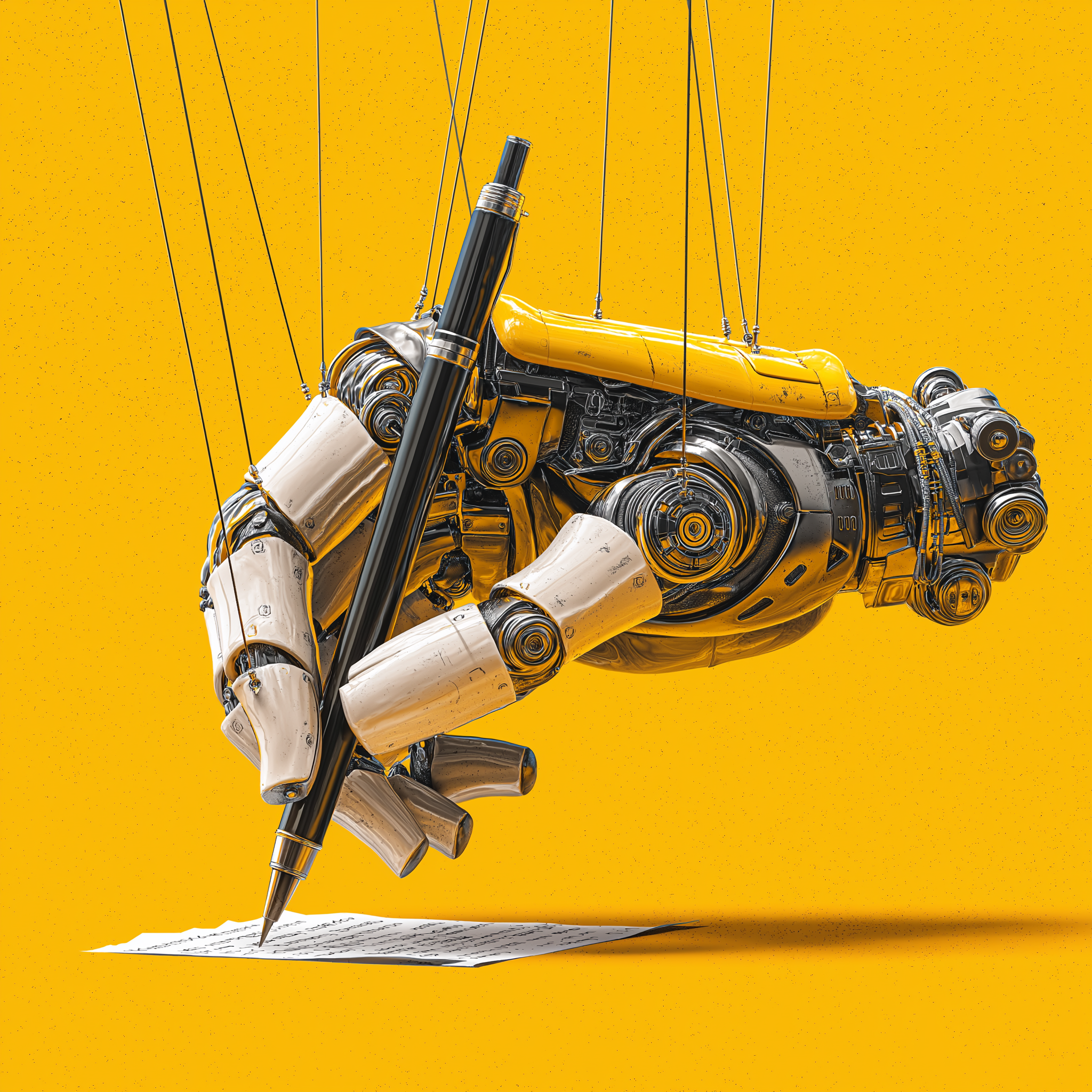
Something interesting is happening on the frontline; something I call Agentic Artistry.
More and more people are building AI agents. I am not talking about tech geeks but kids in their teens and folks over 60. They are not just using AI but they are creating the AI agents that power them to create in new and exciting ways.
They are composing systems of models that talk to each other, hand work back and forth, critique each other’s outputs, search, refine, revise. They are designing the rooms inside which thinking happens. They are choosing which voice does the first draft and which voice tears it apart. They are writing the “constitutions” that govern how these AI collaborators behave, the taste guidelines they answer to, the conditions under which they should refuse the easy answer and try again.
If you watch someone good doing this work, it does not look like engineering or a prompting task.
It looks more like musical orchestration; closer to coordinating an ensemble of capable musicians and their instruments toward a vision that none of them, alone, could reach.
We can only see this level of artistry when we step back from the worries about what AI could do to artistry. In fact, I believe we are actually witnessing the birth of a new creative discipline – Agentic Artistry.
This creative discipline is forming with its own grammar, its own masters and amateurs, its own emerging canon. Painting was not photography. Photography was not film. Film was not television. Each creative discipline absorbed what came before and added a dimension the prior medium could not reach. Agentic artistry — the design of intelligent systems that produce creative outcomes — is one of those additions. It is not a thinner version of writing or art. It is a richer, deeper type of creativity that has writing or art or music inside it.
And – this is the part my friend rejected – this discipline does not reduce the role of taste. It increases it. When the marginal cost of producing output collapses, the only thing left that distinguishes a good piece from a forgettable one is the creative judgment of the person at the helm. What did they refuse? What did they cut? What did they push the system to try again, and again, until it found the sentence that meant something?
While it may seem to people that the AI agent is in charge, in fact, it is the artist who says no.
By the end of the evening, I realized both things are true at once.
It is true that an enormous quantity of optimized, frictionless, almost-content is going to flood every channel we have, and that some real fraction of human attention is going to be captured by it. This will reshape what people expect from any artistic endeavor and for some it will degrade their appreciation for human creativity. My friend is right about that and there is no pretending this is not a real risk.
It is also true, however, that at the same time, a growing number of people are doing something extraordinary with these systems that has never been possible before — building, composing, directing intelligence. Very soon indeed, the best of this work is going to look just as creative as anything a human produced. With agentic artistry, it is human creativity only expressed through a new tool.
In my mind, it is not about which of these futures wins. Both will exist, simultaneously, the way junk food and great restaurants exist simultaneously.
The pivotal question that is worth considering is how we build the conditions under which the human creative spirit thrives to find its audience inside an ocean of the AI slop.
How do we teach taste in a world where taste is the only scarce resource left?
How do we keep the friction that makes the creative work “work”?
How do we recognize, name, and reward the people who are creating with this the new discipline well, so well that it is elevated to be recognized as an art form?
I don’t know. We are early. The artistic structure is just forming now. The masters have not been crowned, and the scope of agentic artistry is embryonic.
It’s true – the slop might win. But if it does, it won’t be because the tools made it inevitable. It will be because the rest of us didn’t bother to develop the taste, or build the creative intuition or do the harder work. AI isn’t going to save us, and it isn’t going to doom us either. It’s just going to be there, vast and capable and indifferent, waiting to be used well or badly.
The rest is up to whoever shows up. It is a work in progress.